
📘 Book break: The Metamorphosis – Franz Kafka
🇮🇹 La metamorfosi – Franz Kafka → Leggi in italiano
🇷🇴 Metamorfoza – Franz Kafka → Citește în română
🪳 PART I – The Beginning of the Metamorphosis
📖 Narrative Summary
🪳 Monstrous awakening
Gregor Samsa wakes up in his bed, transformed into a giant insect. No explanation—just the bare, unacceptable fact.
💼 Work anxiety
His first fear isn’t his altered body, but being late. He’s terrified of losing his job and disappointing his boss.
🛏️ Trapped in bed
Lying helpless on his back, he reflects on the exhausting weight of his life. He feels the burden of financial responsibility toward his family.
🚪 First contact
After grotesque efforts, he manages to open the door. His family and the office manager see him—and recoil in horror.
❌ Rejection
His father drives him back violently. Wounded, Gregor retreats to his room. The door closes behind him. His isolation has begun.
🔑 Keywords
- Transformation: unexplained but total. Reality shifts beneath his feet without warning.
- Insect: not just grotesque—it’s a symbol of rejection, exclusion, social shame.
- Family: confused at first, then afraid, finally hostile. Love turns into burden.
- Work: mechanical, oppressive, obsessively present—even after the body has changed.
- Shame: Gregor worries more about being a burden than being a monster. Judgment crushes him.
🧠 Mental Images
- Gregor lying on his back, legs twitching in the air, unable to turn.
- His mother crying behind the door as the lock slowly turns.
- The office manager backing away in horror, as if it were Gregor’s fault.
- His father driving him back with a cane as he crawls away, helpless.
📝 Quotes to Remember
“When Gregor Samsa woke up one morning from unsettling dreams, he found himself changed in his bed into a monstrous vermin.”
A striking beginning. No explanation—just the fact. Kafka doesn’t ease us in; he drops us into the transformation.
“What’s happened to me?”
A simple, disarming question. Kafka offers no answers. Identity is already fractured.
“They couldn’t understand his words anymore.”
Language no longer connects. He speaks, but no one understands. He’s already outside humanity.
🪳 PART II – The Growing Exclusion
📖 Narrative Summary
🚪 Increasing isolation
Gregor remains confined to his room. The family tends to him out of necessity, not empathy. His father, mother, and Grete are deeply unsettled.
🧹 Grete’s role
Grete takes care of him—bringing food, cleaning the room. But something shifts. Her compassion turns into fatigue, then into irritation.
💔 The weight of rejection
The family is now facing financial hardship. The father becomes more aggressive, and Gregor feels his own body as an oppressive burden.
🚫 Assault and retreat
His father attacks him. Gregor withdraws, increasingly alienated. The distance between him and the others becomes unbridgeable.
🧩 Family breakdown
Even among themselves, the family’s bonds begin to fray. Gregor is forgotten. The house grows quieter, colder, emptier.
🔑 Keywords
- Isolation: both physical and psychological separation from the world.
- Alienation: emotional disconnection from his family, deepening over time.
- Shame: Gregor retreats into his condition, accepting their rejection.
- Family: from initial concern to hostility and eventual indifference.
🧠 Mental Images
- Gregor’s room—dark, sealed off, a personal prison.
- His father driving him away with fury.
- Grete, now distant, placing food down without meeting his gaze.
- The door slammed shut after every encounter.
📝 Quotes to Remember
“He could no longer imagine anything that would soothe or comfort him, he was completely in the grip of his suffering and his condition.”
The realization of complete helplessness: hope fades, replaced by emotional desolation.
“It was as if his family had forgotten that he had ever existed.”
A reflection on detachment: Gregor, though still human, is now perceived as something alien.
“His sight dimmed more and more; he could barely move. The pain in his side was turning into a dull throbbing ache, and he was filled with a sense of complete abandonment.”
Gregor’s body becomes a symbol of suffering that no longer finds any echo in the world around him.
🪳 PART III – The End of the Journey
📖 Narrative Summary
🌙 An unbearable presence
Gregor has become an unsustainable burden. He no longer communicates. He lies still, hidden, listening to life carry on without him.
🎻 Grete’s violin concert
One evening, Grete plays the violin for the lodgers. Drawn by the music, Gregor slowly emerges from his room.
😱 The scandal
The lodgers, seeing him, threaten to leave. It’s the final straw. Grete declares that Gregor must go.
🌑 The final night
Wounded in both body and soul, Gregor returns to his room. He dies in silence, without anyone saying goodbye. He is discovered only in the morning.
🌅 After Gregor
The family awakens. It’s as if light returns. They step outside for the first time, deciding to move away. Grete smiles. They speak of the future.
🧠 Mental Images
- Gregor curled in the shadows, invisible yet still present.
- The sound of the violin weaving through the house like a final call.
- The stern gaze of the lodgers, dominating the room.
- Grete standing up, condemning him with a decisive sentence.
- Gregor’s lifeless body, stiff and cold, discovered only the next day.
📝 Quotes to Remember
“He thought that it might be best if he disappeared altogether.”
The awareness that there’s no place left for him. No one looks for him. No one holds him back.
“He died as the day was dawning.”
A dry, cold closure. No mercy. Just an ending.
“They felt relieved and at peace.”
After death, the family resumes life. But at what cost?
🎯 Personal Conclusion
Franz Kafka’s The Metamorphosis offers profound reflections on alienation, loneliness, and the burden of societal, familial, and personal expectations. Here are some of the key takeaways the story may leave you with:
- The importance of self-acceptance: Gregor’s transformation symbolizes how essential it is to recognize and accept oneself, even when feeling different or out of place.
- The weight of duty: Sacrificing yourself for others should never mean erasing your own identity. Self-care must come first.
- The fragility of family bonds: Relationships aren’t always solid. Even those closest to you may drift away when you need them most.
- The pain of loneliness: Isolation is not only physical but, more deeply, emotional. It must be acknowledged and transformed.
Key insight: Even when you feel alienated, lost, or let down, you are not alone. Your inner voice deserves to be heard and respected.
🗣 Quotes to Say Out Loud
“Don’t let the weight of duty dim the light within you.”
It will remind you that while responsibilities matter, you should never sacrifice your well-being and authenticity.
“Even in solitude, I can find my strength.”
It will help you remember that although solitude can hurt, it can also be a powerful source of personal growth.
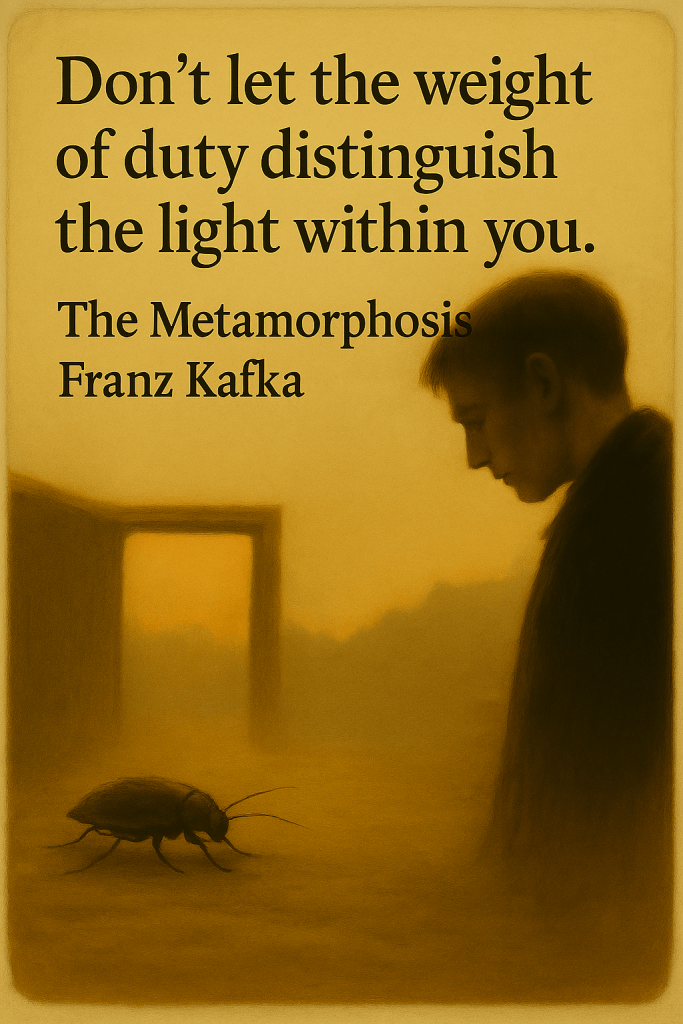
Non permettere che il peso del dovere oscuri la luce che c’è in te.
📥 Scarica il poster in formato A5 (PDF)
❓ Frequently Asked Questions about “The Metamorphosis” by Franz Kafka
- What is the symbolic meaning of Gregor Samsa’s transformation?
- Turning into a bug is not the tragedy — being unseen is. Gregor’s metamorphosis reveals the brutal alienation of the modern self: reduced, misunderstood, erased.
“When Gregor Samsa woke one morning from troubled dreams, he found himself transformed in his bed into a horrible vermin.” - Why does Gregor’s family reject him?
- They don’t recognize him anymore — and maybe they never did. Once he’s no longer useful, affection cracks and duty turns cold.
“He would have used his arms and his hands to push himself up; but instead of them he only had all those little legs continuously moving in different directions.” - What role does duty play in the story?
- Gregor sacrifices everything — even himself — to keep working, to keep providing. But Kafka shows the weight of duty can quietly destroy what it claims to protect.
“He was a tool of the boss, without brains or backbone.” - How does Kafka portray loneliness?
- It’s not just the locked room — it’s the silence around it. Gregor’s body changes, but the real transformation is in how no one dares to see him.
“He would have spoken to them and explained everything, if they hadn’t been so afraid of him.” - What is the final message of the story?
- Gregor dies, and the family breathes easier. No grief, just relief. Kafka’s ending cuts deep: when someone becomes inconvenient, we learn how conditional our empathy really is.
“And it was like a confirmation of their new dreams and good intentions when at the end of their journey their daughter got up first and stretched her young body.”
If this quote spoke to you too, let me know in the comments. I always reply with pleasure.
Leave a Comment
Submit CommentSupport this project
With a small gesture, you can help publish new quotes and books every week. Every contribution helps keep this space alive.

Scan to donate via PayPal

Scan to donate via Satispay
*Comments and automatic sections appear in Italian — this blog lives between two languages.*
📬 Did this quote speak to you?
Receive one every Tuesday with Una frase per restare.
✉️ Subscribe to the newsletter
 Una frase per restare
Lascia un commento